Filters
Question type

Study Flashcards

A container was charged with hydrogen,nitrogen,and ammonia gases at 120°C and the system was allowed to reach equilibrium.What will happen if the volume of the container is increased at constant temperature? 3H2(g) + N2(g) A container was charged with hydrogen,nitrogen,and ammonia gases at 120°C and the system was allowed to reach equilibrium.What will happen if the volume of the container is increased at constant temperature? 3H<sub>2</sub>(g) + N<sub>2</sub>(g)    2NH<sub>3</sub>(g)  A) There will be no effect. B) More ammonia will be produced at the expense of hydrogen and nitrogen. C) Hydrogen and nitrogen will be produced at the expense of ammonia. D) The equilibrium constant will increase. E) The equilibrium constant will decrease. 2NH3(g)


A) There will be no effect.
B) More ammonia will be produced at the expense of hydrogen and nitrogen.
C) Hydrogen and nitrogen will be produced at the expense of ammonia.
D) The equilibrium constant will increase.
E) The equilibrium constant will decrease.

F) A) and E)
G) C) and D)

Correct Answer

verifed

verified

A quantity of liquid methanol,CH3OH,is introduced into a rigid 3.00-L vessel,the vessel is sealed,and the temperature is raised to 500 K.At this temperature,the methanol vaporizes and decomposes according to the reaction CH3OH(g) A quantity of liquid methanol,CH<sub>3</sub>OH,is introduced into a rigid 3.00-L vessel,the vessel is sealed,and the temperature is raised to 500 K.At this temperature,the methanol vaporizes and decomposes according to the reaction CH<sub>3</sub>OH(g)    CO(g) + 2H<sub>2</sub>(g) ,K<sub>c</sub> = 6.90 ×10<sup>-2</sup> If the concentration of H<sub>2</sub> in the equilibrium mixture is 0.426 M,what mass of methanol was initially introduced into the vessel? A) 147 g B) 74.3 g C) 33.9 g D) 49.0 g E) 24.8 g CO(g) + 2H2(g) ,Kc = 6.90 ×10⁻² If the concentration of H2 in the equilibrium mixture is 0.426 M,what mass of methanol was initially introduced into the vessel?


A) 147 g
B) 74.3 g
C) 33.9 g
D) 49.0 g
E) 24.8 g

F) A) and E)
G) A) and D)

Correct Answer

verifed

verified

Nitric oxide and bromine were allowed to react in a sealed container.When equilibrium was reached,the following partial pressures of three gases were measured: NO: 0.526 atm; Br2 :1.59 atm; NOBr: 7.68 atm.Calculate KP for the reaction. 2NO(g) + Br2(g) Nitric oxide and bromine were allowed to react in a sealed container.When equilibrium was reached,the following partial pressures of three gases were measured: NO: 0.526 atm; Br<sub>2</sub> :1.59 atm; NOBr: 7.68 atm.Calculate K<sub>P</sub> for the reaction. 2NO(g) + Br<sub>2</sub>(g)    2NOBr(g)  A) 7.45 × 10<sup>-3</sup> B) 0.109 C) 9.18 D) 91.8 E) 134 2NOBr(g)


A) 7.45 × 10⁻³
B) 0.109
C) 9.18
D) 91.8
E) 134

F) A) and B)
G) C) and D)

Correct Answer

verifed

verified

The equilibrium constant,KP,has a value of 6.5 × 10⁻⁴ at 308 K for the reaction of nitrogen monoxide with chlorine. 2NO(g) + Cl2(g) The equilibrium constant,K<sub>P</sub>,has a value of 6.5 × 10<sup>-4</sup> at 308 K for the reaction of nitrogen monoxide with chlorine. 2NO(g) + Cl<sub>2</sub>(g)    2NOCl(g)  What is the value of K<sub>c</sub>? (R = 0.08206 L • atm/K • mol)  A) 2.5 × 10<sup>-7</sup> B) 6.5 × 10<sup>-4</sup> C) 1.6 × 10<sup>-2</sup> D) 1.7 E) None of these choices is correct. 2NOCl(g) What is the value of Kc? (R = 0.08206 L • atm/K • mol)


A) 2.5 × 10⁻⁷
B) 6.5 × 10⁻⁴
C) 1.6 × 10⁻²
D) 1.7
E) None of these choices is correct.

F) B) and E)
G) A) and B)

Correct Answer

verifed

verified

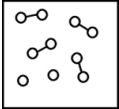
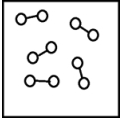
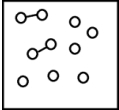
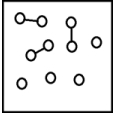
For the endothermic reaction A2(g) For the endothermic reaction A2(g)    2A(g) ,a snapshot of an equilibrium mixture of A(g) and A2(g) at low temperature may look as follows.(Each circle represents 1.0 mol of A atoms,and the volume of the box is 1.0 L.)    If the system pressure is lowered,what might the new equilibrium system look like? A)    B)    C)    D)    E)   2A(g) ,a snapshot of an equilibrium mixture of A(g) and A2(g) at low temperature may look as follows.(Each circle represents 1.0 mol of A atoms,and the volume of the box is 1.0 L.) For the endothermic reaction A2(g)    2A(g) ,a snapshot of an equilibrium mixture of A(g) and A2(g) at low temperature may look as follows.(Each circle represents 1.0 mol of A atoms,and the volume of the box is 1.0 L.)    If the system pressure is lowered,what might the new equilibrium system look like? A)    B)    C)    D)    E)   If the system pressure is lowered,what might the new equilibrium system look like?


A) For the endothermic reaction A2(g)    2A(g) ,a snapshot of an equilibrium mixture of A(g) and A2(g) at low temperature may look as follows.(Each circle represents 1.0 mol of A atoms,and the volume of the box is 1.0 L.)    If the system pressure is lowered,what might the new equilibrium system look like? A)    B)    C)    D)    E)
B) For the endothermic reaction A2(g)    2A(g) ,a snapshot of an equilibrium mixture of A(g) and A2(g) at low temperature may look as follows.(Each circle represents 1.0 mol of A atoms,and the volume of the box is 1.0 L.)    If the system pressure is lowered,what might the new equilibrium system look like? A)    B)    C)    D)    E)
C) For the endothermic reaction A2(g)    2A(g) ,a snapshot of an equilibrium mixture of A(g) and A2(g) at low temperature may look as follows.(Each circle represents 1.0 mol of A atoms,and the volume of the box is 1.0 L.)    If the system pressure is lowered,what might the new equilibrium system look like? A)    B)    C)    D)    E)
D) For the endothermic reaction A2(g)    2A(g) ,a snapshot of an equilibrium mixture of A(g) and A2(g) at low temperature may look as follows.(Each circle represents 1.0 mol of A atoms,and the volume of the box is 1.0 L.)    If the system pressure is lowered,what might the new equilibrium system look like? A)    B)    C)    D)    E)
E) For the endothermic reaction A2(g)    2A(g) ,a snapshot of an equilibrium mixture of A(g) and A2(g) at low temperature may look as follows.(Each circle represents 1.0 mol of A atoms,and the volume of the box is 1.0 L.)    If the system pressure is lowered,what might the new equilibrium system look like? A)    B)    C)    D)    E)

F) C) and D)
G) A) and C)

Correct Answer

verifed

verified

Which is the correct equilibrium constant expression for the following reaction? 2BrCl3(g) Which is the correct equilibrium constant expression for the following reaction? 2BrCl<sub>3</sub>(g)    Br<sub>2</sub>(g) + 3Cl<sub>2</sub>(g)  A) K<sub>c</sub> = [Br<sub>2</sub>] [Cl<sub>2</sub>]/[BrCl<sub>3</sub>] B) K<sub>c</sub> = [Br<sub>2</sub>] [Cl<sub>2</sub>]<sup>5</sup>/[BrCl<sub>3</sub>]<sup>2</sup> C) K<sub>c</sub> = [Br<sub>2</sub>] [Cl<sub>2</sub>]<sup>3</sup>/[BrCl<sub>3</sub>]<sup>2</sup> D) K<sub>c</sub> = [BrCl<sub>3</sub>]<sup>2</sup>/([Br<sub>2</sub>] × [Cl<sub>2</sub>]<sup>3</sup>)  E) K<sub>c</sub> = 2[BrCl<sub>3</sub>]<sup>2</sup>/([Br<sub>2</sub>] × 3[Cl<sub>2</sub>]<sup>3</sup>) Br2(g) + 3Cl2(g)


A) Kc = [Br2] [Cl2]/[BrCl3]
B) Kc = [Br2] [Cl2]5/[BrCl3]2
C) Kc = [Br2] [Cl2]3/[BrCl3]2
D) Kc = [BrCl3]2/([Br2] × [Cl2]3)
E) Kc = 2[BrCl3]2/([Br2] × 3[Cl2]3)

F) A) and E)
G) A) and D)

Correct Answer

verifed

verified

When the concentrations of both the reactants and products remain constant because the forward and reverse reactions are occurring at the same rate then the system is ________________.

Correct Answer

verifed

verified

If,in a particular process,reactants are able to form products,and products are also able to form reactants,then this process may be described as


A) a reversible process.
B) an elementary process.
C) at equilibrium.
D) forbidden.
E) a forward process.

F) B) and D)
G) A) and E)

Correct Answer

verifed

verified

Consider the equilibrium reaction: N2O4(g) Consider the equilibrium reaction: N<sub>2</sub>O<sub>4</sub>(g)    2NO<sub>2</sub>(g)  Which of the following correctly describes the relationship between K<sub>c</sub> and K<sub>P</sub> for the reaction? A) K<sub>P</sub> = K<sub>c</sub> B) K<sub>P</sub> = RT × K<sub>c</sub> C) K<sub>P</sub> = (RT × K<sub>c</sub> ) -1 D) K<sub>P</sub> = K<sub>c</sub>/RT E) K<sub>P</sub> = RT/K<sub>c</sub> 2NO2(g) Which of the following correctly describes the relationship between Kc and KP for the reaction?


A) KP = Kc
B) KP = RT × Kc
C) KP = (RT × Kc ) -1
D) KP = Kc/RT
E) KP = RT/Kc

F) B) and E)
G) A) and D)

Correct Answer

verifed

verified

Consider the reversible reaction: 2NO2(g) Consider the reversible reaction: 2NO<sub>2</sub>(g)    N<sub>2</sub>O<sub>4</sub>(g)  If the concentrations of both NO<sub>2</sub> and N<sub>2</sub>O<sub>4</sub> are each 0.016 M,what is the value of Q<sub>c</sub>? A) 0.016 B) 0.50 C) 1.0 D) 2.0 E) 63 N2O4(g) If the concentrations of both NO2 and N2O4 are each 0.016 M,what is the value of Qc?


A) 0.016
B) 0.50
C) 1.0
D) 2.0
E) 63

F) B) and E)
G) All of the above

Correct Answer

verifed

verified

At 250ºC,the equilibrium constant,KP,for the reaction PCl5(g) At 250ºC,the equilibrium constant,K<sub>P</sub>,for the reaction PCl<sup>5</sup>(g)    PCl<sub>3</sub>(g) + Cl<sub>2</sub>(g) is 1.80. Sufficient PCl<sub>5</sub> is put into a reaction vessel to give an initial pressure of 2.74 atm at 250ºC.What is the partial pressure of PCl<sub>5</sub> after the system has reached equilibrium. A) 1.50 atm B) 1.24 atm C) 4.24 atm D) 0.94 atm E) 1.12 atm PCl3(g) + Cl2(g) is 1.80. Sufficient PCl5 is put into a reaction vessel to give an initial pressure of 2.74 atm at 250ºC.What is the partial pressure of PCl5 after the system has reached equilibrium.


A) 1.50 atm
B) 1.24 atm
C) 4.24 atm
D) 0.94 atm
E) 1.12 atm

F) A) and D)
G) C) and D)

Correct Answer

verifed

verified

Suppose 50.0 g of N2O4 is introduced into an evacuated 2.00-L vessel and allowed to come to equilibrium with its decomposition product,N2O4(g) Suppose 50.0 g of N<sub>2</sub>O<sub>4</sub> is introduced into an evacuated 2.00-L vessel and allowed to come to equilibrium with its decomposition product,N<sub>2</sub>O<sub>4</sub>(g)    2NO<sub>2</sub>(g) .For this reaction K<sub>c</sub> = 0.133.Once the system has reached equilibrium,5.00 g of NO2 is injected into the vessel,and the system is allowed to equilibrate once again.What is the mass of NO<sub>2</sub> in the final equilibrium mixture? A) 7.8 g B) 12.4 g C) 14.7 g D) 19.7 g E) 15.5 g 2NO2(g) .For this reaction Kc = 0.133.Once the system has reached equilibrium,5.00 g of NO2 is injected into the vessel,and the system is allowed to equilibrate once again.What is the mass of NO2 in the final equilibrium mixture?


A) 7.8 g
B) 12.4 g
C) 14.7 g
D) 19.7 g
E) 15.5 g

F) A) and B)
G) A) and C)

Correct Answer

verifed

verified

The equilibrium constant KP at 427°C for the reaction N2(g) + 3H2(g) The equilibrium constant K<sub>P</sub> at 427°C for the reaction N<sub>2</sub>(g) + 3H<sub>2</sub>(g)    2NH<sub>3</sub>(g) is 9.4 ×10<sup>-5</sup>.What is ΔG° for the reaction under these conditions? (R = 8.314 J/K • mol)  A) -33 kJ/mol B) -54 kJ/mol C) 54 kJ/mol D) 33 kJ/mol E) 1.3 J/mol 2NH3(g) is 9.4 ×10⁻⁵.What is ΔG° for the reaction under these conditions? (R = 8.314 J/K • mol)


A) -33 kJ/mol
B) -54 kJ/mol
C) 54 kJ/mol
D) 33 kJ/mol
E) 1.3 J/mol

F) None of the above
G) C) and D)

Correct Answer

verifed

verified

Hydrogen sulfide can be formed in the following reaction: H2(g) + S2(g) Hydrogen sulfide can be formed in the following reaction: H<sub>2</sub>(g) + S<sub>2</sub>(g)    H<sub>2</sub>S(g) ; ΔH°<sub>rxn</sub> = -92 kJ/mol The equilibrium constant,K<sub>P</sub>,is 106 at 1023 K.Estimate the value of K<sub>P</sub> at 1218 K.(R = 8.314 J/K • mol)  A) 5.05 B) 18.8 C) 34.7 D) 88.9 E) 598 H2S(g) ; ΔH°rxn = -92 kJ/mol The equilibrium constant,KP,is 106 at 1023 K.Estimate the value of KP at 1218 K.(R = 8.314 J/K • mol)


A) 5.05
B) 18.8
C) 34.7
D) 88.9
E) 598

F) None of the above
G) A) and E)

Correct Answer

verifed

verified

Suppose 75.0 g of PCl5(g) is introduced into an evacuated 3.00-L vessel and allowed to reach equilibrium at 250ºC. PCl5(g) Suppose 75.0 g of PCl<sub>5</sub>(g) is introduced into an evacuated 3.00-L vessel and allowed to reach equilibrium at 250ºC. PCl<sub>5</sub>(g)    PCl<sub>3</sub>(g) + Cl<sub>2</sub>(g)  If K<sub>P</sub> = 1.80 for this reaction,what is the total pressure inside the vessel at equilibrium? (R =0.0821 atm • L/mol • K)  A) 2.88 atm B) 2.28 atm C) 4.54 atm D) 7.43 atm E) 9.69 atm PCl3(g) + Cl2(g) If KP = 1.80 for this reaction,what is the total pressure inside the vessel at equilibrium? (R =0.0821 atm • L/mol • K)


A) 2.88 atm
B) 2.28 atm
C) 4.54 atm
D) 7.43 atm
E) 9.69 atm

F) C) and E)
G) C) and D)

Correct Answer

verifed

verified

Which substances are included in the equilibrium constant expression,Kc?


A) Only pure solids
B) Only pure liquids
C) Only pure solids and liquids
D) Only gases and dissolved substances
E) All participating substances

F) C) and D)
G) A) and C)

Correct Answer

verifed

verified

In the gas phase,formic acid forms a dimer,2HCOOH(g) In the gas phase,formic acid forms a dimer,2HCOOH(g)    (HCOOH) <sub>2</sub>(g) .For this reaction,ΔH° = -60.1 kJ/mol and ΔG° = -13.9 kJ/mol at 25°C.Find the equilibrium constant (K<sub>P</sub>) for this reaction at 75 °C. A) 8960 B) 273 C) 0.120 D) 8.33 E) 1.12 × 10<sup>-4</sup> (HCOOH) 2(g) .For this reaction,ΔH° = -60.1 kJ/mol and ΔG° = -13.9 kJ/mol at 25°C.Find the equilibrium constant (KP) for this reaction at 75 °C.


A) 8960
B) 273
C) 0.120
D) 8.33
E) 1.12 × 10⁻⁴

F) A) and B)
G) B) and C)

Correct Answer

verifed

verified

If the system 3H2(g)+ N2(g) If the system 3H<sub>2</sub>(g)+ N<sub>2</sub>(g)   2NH<sub>3</sub>(g)is at equilibrium and more N<sub>2</sub> is added,a net reaction that consumes some of the added N<sub>2</sub> will occur until a new equilibrium is reached. 2NH3(g)is at equilibrium and more N2 is added,a net reaction that consumes some of the added N2 will occur until a new equilibrium is reached.

A) True
B) False

Correct Answer

verifed

verified

Which statement is correct?


A) When Q < K then ΔG = 1.
B) When Q < K then ΔG = -ΔS.
C) When Q = K then ΔG = 0.
D) When Q > K then ΔG = 1.
E) When Q > K then ΔG = - RT.

F) A) and B)
G) A) and E)

Correct Answer

verifed

verified

A mixture of 0.500 mole of carbon monoxide and 0.400 mole of bromine was placed into a rigid 1.00-L container and the system was allowed to come to equilibrium.The equilibrium concentration of COBr2 was 0.233 M.What is Kc for this reaction? CO(g) + Br2(g) A mixture of 0.500 mole of carbon monoxide and 0.400 mole of bromine was placed into a rigid 1.00-L container and the system was allowed to come to equilibrium.The equilibrium concentration of COBr<sub>2</sub> was 0.233 M.What is K<sub>c</sub> for this reaction? CO(g) + Br<sub>2</sub>(g)    COBr<sub>2</sub>(g)  A) 5.23 B) 2.14 C) 1.17 D) 0.467 E) 0.191 COBr2(g)


A) 5.23
B) 2.14
C) 1.17
D) 0.467
E) 0.191

F) A) and E)
G) A) and B)

Correct Answer

verifed

verified

Showing 81 - 100 of 135

Related Exams

Show Answer