B) False
Correct Answer

verified
Correct Answer
verified
A) The solid phase has a lower density than the liquid phase.
B) The triple point is at a higher temperature than the normal melting point.
C) The substance changes from a solid to a liquid as one follows the line from C to D.
D) The substance changes from a liquid to a gas as one follows the line from C to D.
E) Point B represents the critical temperature and pressure for the substance.
G) B) and E)
Correct Answer
verified
Correct Answer
verified
A) 4
B) 6
C) 8
D) 10
E) 12
G) A) and B)
Correct Answer
verified
Correct Answer
verified
A) liquid
B) vapor
C) rhombic solid
D) monoclinic solid
E) liquid-vapor boundary line
G) B) and C)
Correct Answer
verified
Correct Answer
verified
A) vapor + liquid
B) vapor
C) liquid
D) solid
E) supercritical fluid
G) B) and E)
Correct Answer
verified
Correct Answer
verified
A) 2.26 g
B) 4.18 g
C) 75.2 g
D) 4.18 ×10³ g
E) 4.07 × 10⁴ g
G) B) and E)
Correct Answer
verified
Correct Answer
verified
A) Surface tension
B) Adhesion
C) Polarity
D) Viscosity
E) Cohesion
G) B) and C)
Correct Answer
verified
Correct Answer
verified
A) 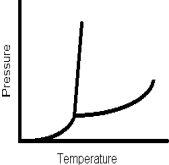
B) 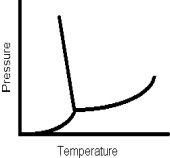
C) 
D) 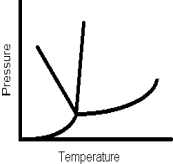
E) 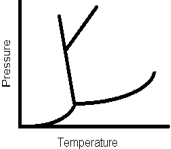
G) None of the above
Correct Answer
verified
Correct Answer
verified
A) dipole-dipole forces.
B) London dispersion forces.
C) hydrogen bonding.
D) ion-dipole interactions.
E) carbon-carbon bonds.
G) C) and D)
Correct Answer
verified
Correct Answer
verified
A) 
B) PH3,NH3
C) CF4,CBr4
D) C3H8,C4H10
E) F2,Cl2
G) A) and C)
Correct Answer
verified
Correct Answer
verified
A) 1.
B) 2.
C) 3.
D) 4.
E) 8.
G) A) and B)
Correct Answer
verified
Correct Answer
verified
A) 4.92 kJ
B) 16.0 kJ
C) 34.5kJ
D) 39.4 kJ
E) 182.8kJ
G) All of the above
Correct Answer
verified
Correct Answer
verified
Correct Answer
verified
Correct Answer
verified
A) dipole-dipole forces
B) London dispersion forces
C) ion-dipole forces
D) covalent bonding
E) ion-ion forces
G) A) and B)
Correct Answer
verified
Correct Answer
verified
A) vapor pressure is exactly 1 atmosphere.
B) vapor pressure is equal to or greater than the external pressure.
C) temperature is equal to 273 K (standard temperature) .
D) temperature is greater than room temperature.
E) thermal energy is equal to the heat of vaporization.
G) A) and D)
Correct Answer
verified
Correct Answer
verified
A) Surface tension
B) Adhesion point
C) Meniscus
D) Capillary point
E) Cohesion point
G) A) and E)
Correct Answer
verified
Correct Answer
verified
A) PH3
B) He
C) H2S
D) CH4
E) CH3OH
G) A) and B)
Correct Answer
verified
Correct Answer
verified
A) molar heat of freezing
B) molar heat of fission
C) molar heat of vaporization
D) molar heat of fusion
E) molar heat of condensation
G) A) and E)
Correct Answer
verified
Correct Answer
verified
A) a low heat of vaporization
B) a low critical temperature
C) a low vapor pressure
D) a low boiling point
E) a low melting point
G) C) and E)
Correct Answer
verified
Correct Answer
verified
A) dipole-dipole forces.
B) London dispersion forces.
C) hydrogen bonding.
D) ion-dipole interactions.
E) disulfide linkages.
G) A) and C)
Correct Answer
verified
Correct Answer
verified
Showing 81 - 100 of 135
Related Exams